up the hill of our peninsulalast visit to fish market, we are off to Kyoto
Visit of Kita village famous for traditional thatched roof houses
Hatched roofs now have to be changed every 30 years, used to be closer to every 60 years. This is due to the change in cooking and heating habits, no more open fires. The surroundings cannot produce enough hatching material to keep all the houses with traditional roofs, so only a couple main houses are now maintained as an open air museum.
This town also hosts a peculiar Indigo museum, peculiar as it was created by the passion of one man and is covering all methods of producing indigo – not just limited to Japanese tradition. A true passion!
A Japanese Jean-Pierre!!A Japanese Jean-Pierre!!A Japanese Jean-Pierre!!
So up we were at 4:30 am, ready for the fishing experience…
The net or network of nets as it turned out to be, are already there stationary.He got a far end part of the netWhilst others were still pulling in the other end, manually…Under the eyes of captivated audience…That synchronised activity all of a sudden got interrupted as one fisherman spotted a whole in the net…Including and even most of all by the captain.First fish come in, the big ones are immediately killed – he sure has the technique…Fish are scooped in with landing netsEach type of fish/squid are already pre-sorted as they get on boardMore sorting takes place on the way back.The real sorting will take place on land.Some of the nicer ones are kept for the ryokan customers
There barely enough light to see much, yet.The boat is simply driven over it, until it reaches a strategic place, and they pull a side of a net.Then they lower a dingy into the middle of that net network.Secured…And using motorised device.… and in a fairytale settingWith out much talking, everyone got to help mending the net!Although it clearly was a big problem! As they interrupted the fishing. It was impressive to see them calm but focused on the repairing.Then it was back to fishing…They have a crane to hoist the other side of the net.2 things get in the way, seagulls and jellyfish…We leave the net as we came in…Taï, Fugu, Eel, Squids (at least 2 types), Mackerel, small ray, sort of tiger fish with parrot beak …
What a memorable experience… likely they got less than usually due to our presence and the whole in the net that required immediate mending…
The captain then offered to take us back to see his farther collecting sea weeds!
Back to our harbourOn time for breakfast
Seaweeds are washed…Some say they are already good raw…
Then dried … some may disagree??
That was just the start of out day, then came the visit of Obama…
We paid another quick visit to Kurama to see the temples on the hill. Then off to Obama.
Temple at Ohara, it had burned and statue had to be rebuilt
Nice way to keep the shutters up.Cute little statue in moss riched lawn
Don’t we love these paused photos, one looks so natural!
At Obama…What a diner we were served, heaps of fish!,, Talking to owner it appears he is a professional fisherman with a crew of 5 employees….
Quick lunch at a road station Spot the bear…Our Ryokan is in Ugu, few kilometer north of Obama – Ryokan Uratani He suggested we joined him to see how they fish, which we of course agreed to. Meaning we would meet at 4:30 am
These are pittoresques little villages in the mountains 30’ north of Kyoto. It is so nice and so close to Kyoto that it is maybe better to avoid the touristic season – which we did… Both towns are well known for their temples. Also these villages are on the Kyoto Trail. First half of the green part…
We found a wonderful Ryokan (a level up compared to Minshukus, but still Japanese style), so we spent two nights there and did some trekking around. The place would even deserve a longer stay!
Less grand than Kumano Kodō, but still well marked…. which doesn’t stop us from checking the mapview on Ohara valley and mountain chain leading to Mt Hiei (which was recommended to us, but we did not do this time)down on a ridgenot lost, but still good to check where we are on a map.
Mt Suitai, 577m after passing an anti-wildbore fence and a steep climb! more to the west.more unknown flowersto a temple, not many visitors lately… season hasn’t begun yet!back to our Ryokan as the sun was setting down.
did we mention the good food at this Ryokan? friendly table neighbours gladly help us with the miso nabe. they both work for IKEA!
The next day we went for a full day walk, from Ohara to Kurama on a route parallel to the Kyoto Trail. But first in the morning we went for a tour of Ohara, looking for a food store…
… wrong directionwhat do you think of that helmet?!?!
Off for our day walk, we had a detailed map and were confident of our tour.
We soon came to an area which clearly had severely been impacted by last year’s hurricane season!!But it still all started as a pleasant and easy walk…As it reads: Amagatake, 788m
We met workers, loaded like a mule!!We are still “on the map” – as the Finnish saying goes 😉… still just nice to look at where we are and where to go.Moss on that mountain.Onigiri picnic 🧺
Glad to be there and ready for more
Going down we could see from our map two options: one was along a winding mountain road, the other along a stream in the forest. The one along the stream was more direct, i.e. steep downhill, seems less frequently used but also in a valley that looked promising (on the map)
As soon as we got there, there were signs of even more severe damage from last seasons hurricane…It got tricky and trickier!So it all was for the best!
As that part of forest had not been cleared…After a while it cleared and the valley also opened up …More flowersPassing a dump for green cuttings, they were moving it to a higher up place in the forest. We recovered some nice bamboo walking sticks…Hunters ‘ hut, with inochichi skins
We finally reached KuraWe tried to take a bus back… but would have had to wait too lon, so we walked back….Can not complain about lack of indications…Still clearing after last hurricane season
Seeding some Sugi trees after the hurricane.Looking for some specific species, we found a shop preparing some fresh one, …. but not for sale yet! 🙁
Back to our Ryokan just on time for another nabe and quick furo.
Quite unsure whether to call it Nachi or Katsuura … but it is the end of that stretch of Kumano Kodō. Just down from the pagoda, waterfall and taisha (shrine). Where we overnighted before another half day in the train to return to Megumi and Noriko Ishida in Gifu.
The cat that did not want to move…
Another royal diner!Japanese love cars… but you usually see modern classy or sportive cars: Lexus,Porsche,Toyota Crown,Ferrari…Our top service tour includes rented bikes… but no navigator!!Family size shipyard…Port exit to ocean is very discreetAssuming this is art retro…Mystery what can fit in so narrow buildings.
The place we were staying at also did some catering… here a special order of o-bentos Well sheltered portAlthough it looks like a tiny town and small port… this is one of the largest fleet of tuna fishery!A small hot water source directly in the Pacific Ocean… the man was preparing this natural pool for his grandchildren.Likely it was cheeky of us to get in and look around…Lady using hot spring water which is let to run out freely at certain hours.and on the way back, again time for more emails…
Back to Gifu
Just time for a walk around the Ishida’s home and get more hints about region north of Kyoto.
Walking with Ume, a dog that does not want to walk much… he needs distractions!And when nothing else seems to work… food is usually the last resort !Ever seen a water bottle for dogs??and then down.
Hélène walking a dog… unbelievable!We went up!down to a dam and its lake
Young leaves and fruits of what looked very similar to maple tree…
Small Buddhist temple at end of lake. Kannamiji temple
Then back home under light rain
Mr. Mouth Open and Mr. Mouth Shut.
We had still a bit of time with Megumi and Noriko before heading for Kyoto and surroundings. Time to admire Megumi’s collection of tools / toys!
A big thank you to Noriko and Megumi for your hospitality, visits and advice!we feasted on the last breakfast – a full meal.
Once you find the entrance, you really cannot get lost … it is well marked all along. The path itself is unusually wide for a forest foot path, and also almost over processed – like stone stairs, terraces in middle of the forest – likely traces of ancient renowned pilgrimage routes.
Here and there you can see traces of forestry work…Mind your steps…Traces of logging, but no signs of collecting logs of that size!Getting to our midway overnight…Scattered along the path, in corners, under rocks or remarkable trees… we get to see these little shrines, called Oji
We were really out of the crowded busy Japan!Shades, from yellow to dark green And most of the time, feeling of being a small ant just briefly passing by in this mighty forests….Even down to tinny details… no wonder they invented IkebanaAzaleas… we presumed!Paul! You never told us we had also some forest in Japan!! GF Les Cernes
On our second day of trekking, still majestic forest.
Is that a tree in a tree, or 3 trees, or what…
Carved stones Potential alternative are clearly marked as “Not Kumano”, 🙂And always the possibility of a surprising new plant to discover! (A bit like Yaburehasa ヤブレガサ!? Or Tachifūro)Reaching back the Pacific coast!And at our destination: Nachisan Seiganto-jiTaisha , another tick ✅!
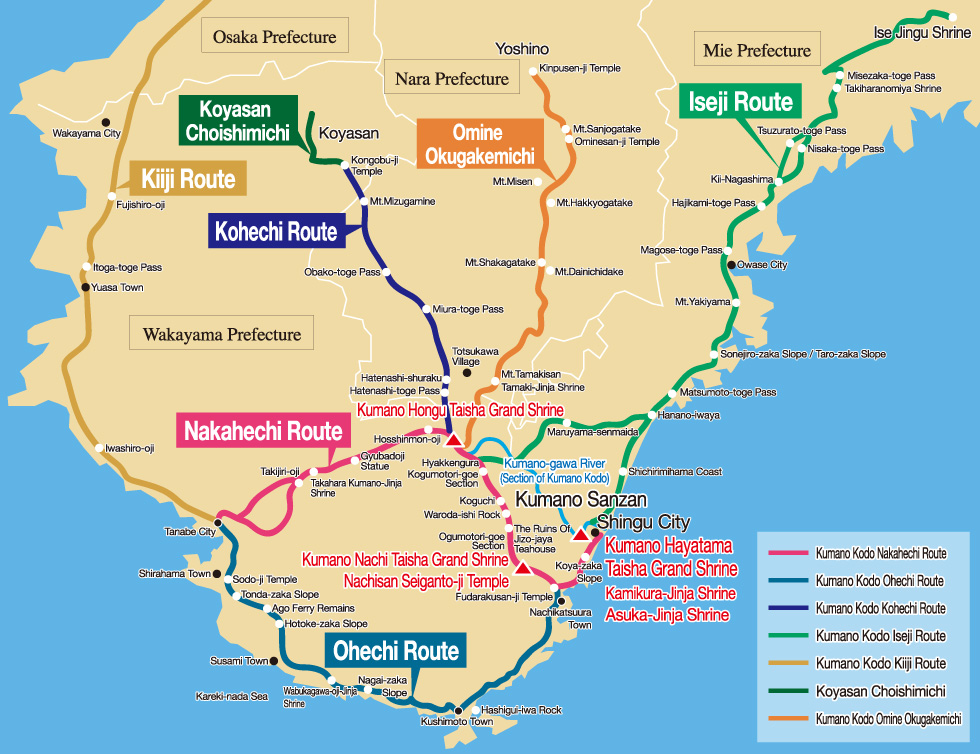
Initially we were thinking to look for walks in the mountains ranges nearby Gifu and up north, but given the weather conditions (still much snow on summits) and following advice from local friends, we switched to more coastal path with famous Kumano Kodō pilgrimage routes (FYI: twinned with Camino de Santiago!). This is located in the Kii Peninsula, south of Osaka.
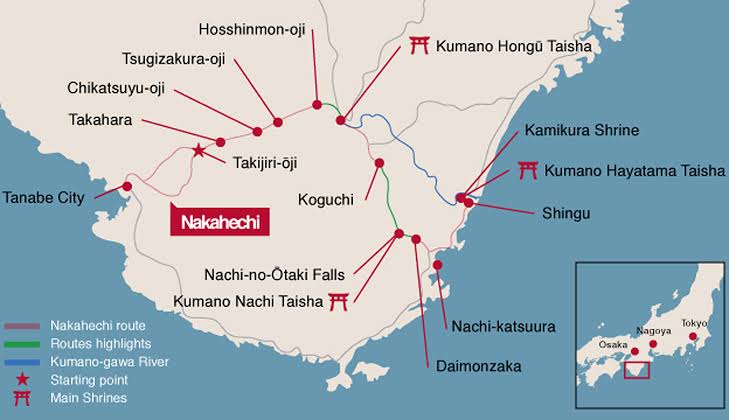
We only spent 3 days there, covering the section from Kumano Hongū Taisha(*) to Kumano Nachi Taisha(*).
(*) taisha: There are various terms used in conjunction with Japanese shrines (神社, jinja), such as taisha (大社) and jingū (神宮). The term taisha was originally a way of referring to a particular shrine in Shimane Prefecture, later (before the Second World War) this shrine title was given to places of Shinto worship nationwide and refer to places with a particular historical background. Shrines that harbour a deep rooted connection with royalty are called jingū in Japanese.
Kumano Kodō / “Sacred Sites and Pilgrimage Routes in the Kii Mountain Range.”
We did the end bit of the red one… 🙂
Declared as UNESCO World Heritage Site in 2004 under the name “Sacred Sites and Pilgrimage Routes in the Kii Mountain Range.”, Kumano Kodō is in fact several pilgrimage routes, we only chose one and even from that one, just a tiny bit…
A few notes about these pilgrimage routes: These routes became famous as the aristocracy and even emperors undertook these pilgrimage and as it is linked to Kumano faith. During the 11th to 13th centuries pilgrimages to Kumano by the Imperial family were repeated almost 100 times. When imperial court undertook this pilgrimage from Kyoto, it would take them 30-40 days… it became such famous pilgrimage that up to ~600 people would form a caravane along with the imperial pilgrimage! The Kumano faith was unique in Japan because it was open to everyone regardless of class, etc.
Shingu city
But first a train from Gifu to Shingu, via Nagoya. A good time to catchup on emails!When ECHA staff hear the sound site, even if spelled as in sightseeing, they look for a chemical plant site… (job conditioning)Shingu (Tankaku) Castle Ruins’ site offers a great overlooking panoramic view around the town and beyond!… to Kamikura-Jinja ShrineThat shrine provides another great view over the city and Pacific Ocean…
Arriving at Shingu, too late to join the Kumano Kodō, so we did a bit of sightseeing….Not just Sakura blooming, but already getting a bit of green too…Good climb to …
A place to visit on 6 Feb… it would seem!
Nothing special… just crossing the railways in the evening light…
Next day we took a bus to get to the starting point of our own little version of pilgrimage… but we also too a day to visit around and enjoy the natural Onsen water – no need rushing! The weather was wet anyway!!
Trekking in forest under an umbrella … just to be stylish!Until we reached Kumano Hongu Taisha shrine… another tick ✅
At a small tea house… no one in, maybe self service?!Through a Sugi forestBrief shelter at a mountain shrine.
Not sure how to comment this….The important Kumano Hongu Taisha temple used to be on this sandbank of Kumano river… until a major flood encourage its relocation on dryer grounds!
Many sightings of land slides all around Japan, they must have become experts on how to consolidate slopes, or at least fix the damage!Yunomine Onsen, a small town with natural hot water springsAnd it seems to work well!!
Wilde cherry trees sticking out from forest.Shirodamo (Neolitsea sericea)Authentic deco in our logging.Bee hives, for wild bees…
Little trouble to get to our starting point… but no shame in U-turning with public transport… just need to be and stay zen!
Next day Megumi had planned for us to meet his group of students, the new school year was just about to start… he had mentioned to them having gaijin guests, Elina being from Finland and their studies in forestry made that quite an event – it appeared… Needless to say we were not prepared for that, but in the end it turned out to be quite informal and very friendly.
There were many sculptures made by chainsaw, most often of bears… and that was not just for Elina Karhu’s visit! (Karhu means bear in Finnish)
Greenhouse at the university… future civil servants had to get their hands in the ground, it could well be their only experience in the field!Each one could do their own toppings We were in need of chopsticks…
We met the group of students in their classroom/study, but immediately went out to prepare pizzas!!Some are eagerly keen to go study abroad… but they need to improve their English a lot!Opportunity for chatsSo we all got busy making our own 箸 (hashi)
Foresters’ axe
University workshop
… well equipped Not well framed photo.. as it was taken by the bear
Kaki & chainsaw sculptures
And We then went to pay a visit to one of Megumi’s friend, a producer of kaki. Gifu region is renowned for its famous kaki, the huge production is exported all around the country. Megumi’s friend is one of the largest producer, a family business which has lasted for 4 generations…
He had just finished trimming and curing the trees…
Special buggy to treat the kaki trees
Their friendship does not come from his profession, but his hobby… when the kaki’s harvest is over, and trees are ready for next season – that friend of his becomes a professional chainsaw sculptor!
He said that to sculpt a bear would now take him less than an hour…
To complete the day we went to see a famous secular cherry tree… Usuzumizakura (根尾谷淡墨桜) an exception as those tree usually hardly go beyond 100 years.
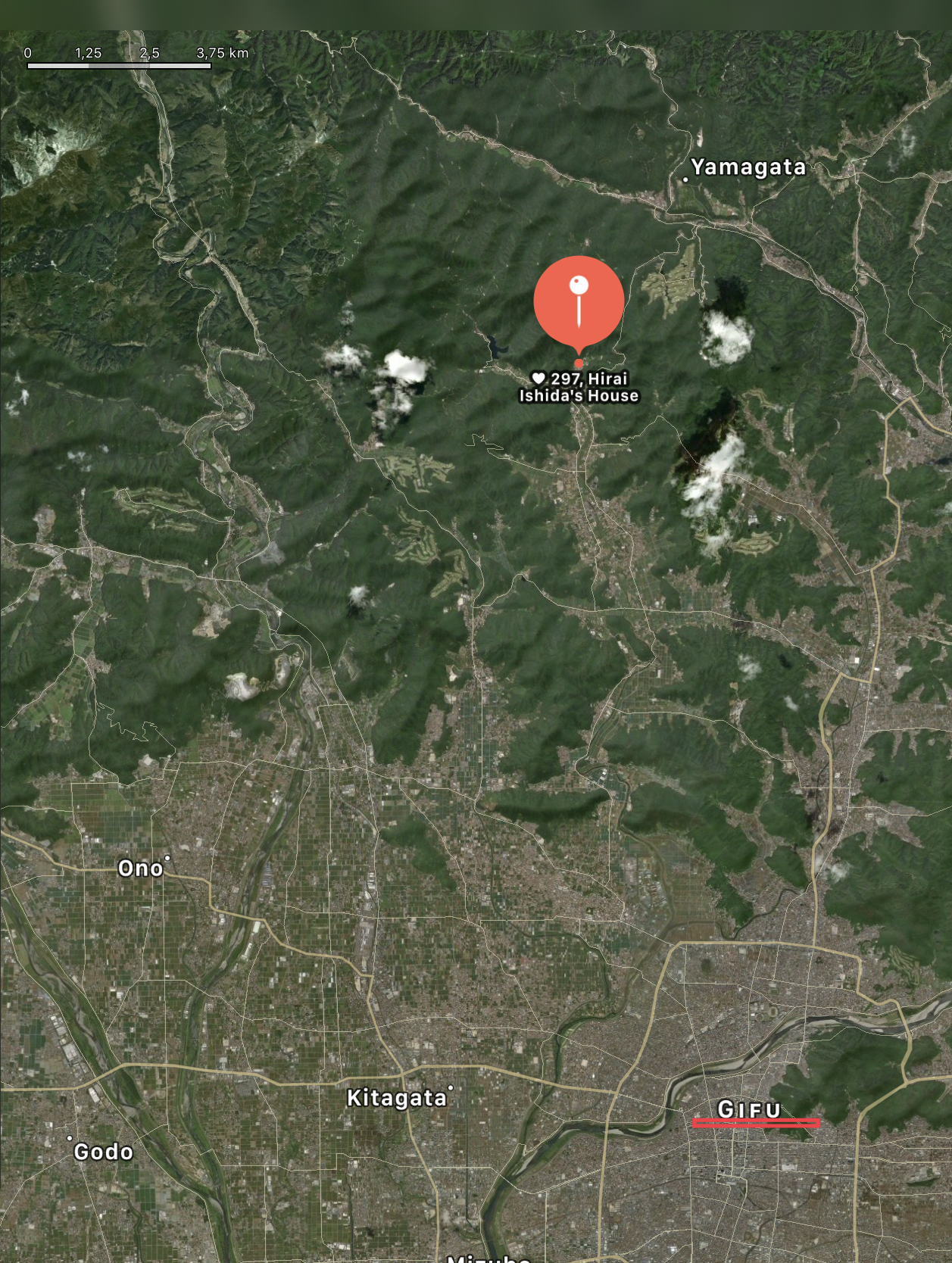
Straight from Tokoname to Gifu to stay at the Ishida’s, Megumi (Rei’s brother) and Noriko. They live some 20’ out in the mountains around Gifu.
Gifu is itself located north of Nagoya, where Megumi is teaching forestry regeneration at University. Its is a bit like the Grenoble of Japan, cold in winter and one of the hottest place in summer as it is at bottom of a bowl.
Spring festival in Nagataki
After collecting us from Gifu station, Megumi brought us straight to his village’s spring festival…. hopping it would not yet be over!
Elina on the left of Hélène.Megumi Ishida on left.Group of children had fun questioning us… mostly on what food we had already tasted and liked.
Most villagers were wearing a special vest for the occasion – happi. Scattered in small chatting groups.Whilst inside the temple a monk was humming a text to another group …
Suddenly we felt the atmosphere was changing, some effervescence in the air… smaller children we grouped inside the temple, the monk changed clothes… some men appeared on top of the temple!!
And then… every man for himself!
Watch-out for pouring mochi!!
You should catch the mochi before it reaches the ground to get full benefits…A typhoon had hit the region and damaged the trees that were around the temple.
… as an early spring festival, it is to hope for good crop season.Surprised by the growth rate, spaced ringsThe Japanese legendary “pissou”! ✌🏼
At the Ishida’s, we were spoilt by Noriko’s cuisine – even for breakfast! …they even remembered our last visit – 27 years ago – and our relish on sukiyaki!
Our WWOOFING experience in Japan coming to its end, our 2 weeks with Elina were more like normal holidays as tourists, although thanks to hospitality and guidance from local friends and thanks to Hélène’s skill in triggering opportunities, we also had some interesting surprises aside from main sightseeing attractions.
As often we did not stay put:
Gifu countryside at the Ishida’s (Rei’s brother and wife, i.e. Go’s uncle and aunt)
Trekking on a short stretch of the Kumano Kodo road
Ohara and Kuramahommachi , north of Kyoto
Obama on Japanese sea coast
Myama and a bit of Kyoto …
Tokoname, just south of Nagoya
Before it came to be a touristic place, Tokoname was a town of industrial potteryIf you give it a close look, at the back in the weed jungle you can see some of those clay pipes and jugs… they are now used to build walls, terraces…Can you make the bike?A kill
As already mentioned we caught up with sakura blooming!Making pipes, cable pipes, sake clay jugs… ( none of which are on these photos..)
This was just a meeting place with Elina, half way between Nagoya and its international airport … a relaxing place to wander around the tiny streets out of frenzy Nagoya and more exotic than airport hall.